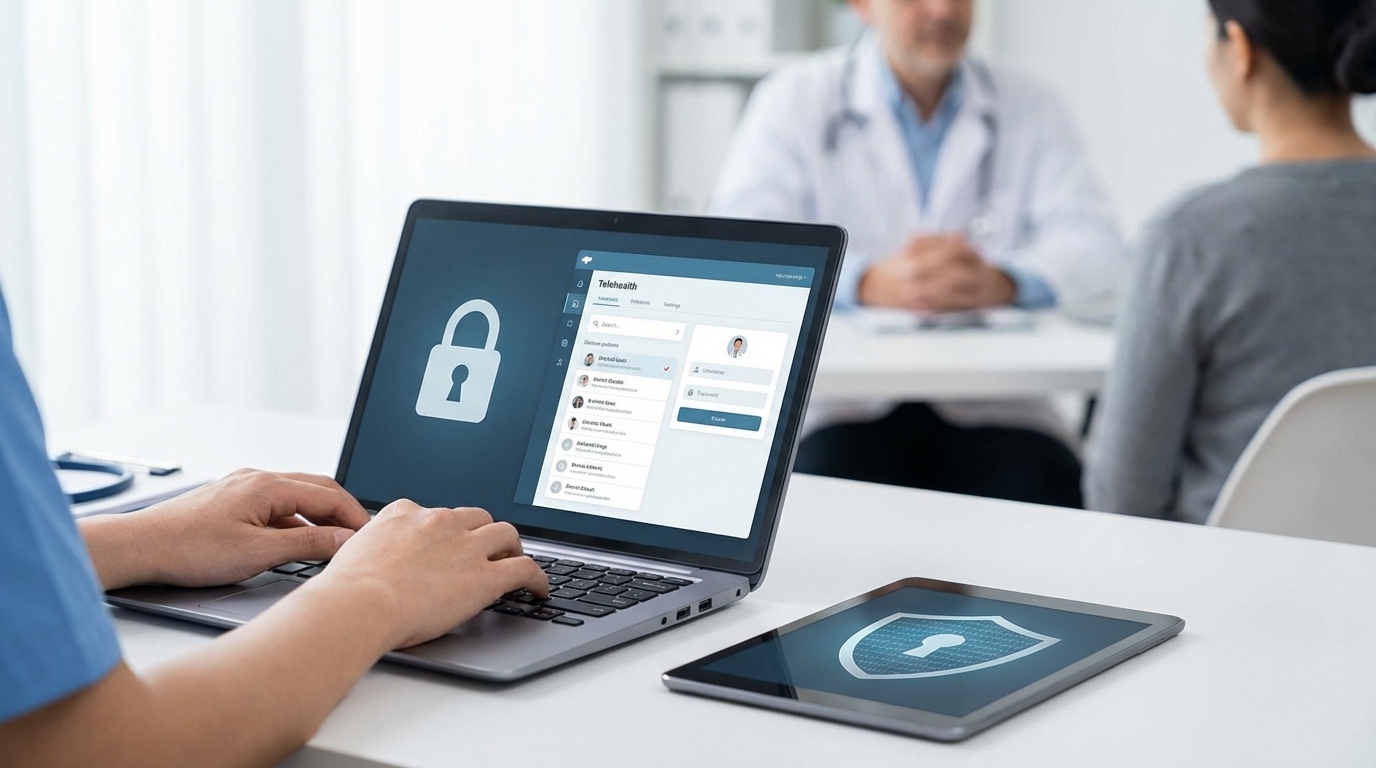
Protecting patient data in virtual clinic environments requires a fundamentally different approach than traditional healthcare security. The good news is that proven strategies exist to defend against these threats. Virtual care providers who implement comprehensive security frameworks not only protect their patients but also build competitive advantages through demonstrated trustworthiness. This guide examines the specific vulnerabilities facing telehealth platforms and provides actionable practices for safeguarding sensitive medical information across every touchpoint of the virtual care experience.
Common vulnerabilities in telehealth platforms
Home networks present a major vulnerability. Most residential routers run outdated firmware with known security flaws. Patients and providers often share these networks with smart TVs, gaming consoles, and IoT devices that rarely receive security updates.
Personal devices compound the problem. When providers use personal laptops or tablets for patient care, organizations lose visibility into security posture. Is the operating system patched? Does antivirus software run current definitions? Has the device been jailbroken or rooted? These questions become nearly impossible to answer without robust mobile device management.
Regulatory Compliance: HIPAA and Beyond
HIPAA's Security Rule establishes the baseline for protecting electronic protected health information. It requires administrative, physical, and technical safeguards. For virtual clinics, technical safeguards demand particular attention: access controls, audit controls, integrity controls, and transmission security all become more complex when care delivery happens remotely.
State laws often impose additional requirements. California's CCPA and CMIA, New York's SHIELD Act, and similar regulations create a patchwork of obligations that virtual clinics must navigate. Organizations serving patients across state lines face the challenge of complying with multiple, sometimes conflicting, regulatory frameworks.
Business associate agreements deserve careful scrutiny. Every vendor handling patient data must sign a BAA, but the document's existence doesn't guarantee the vendor's security practices meet your standards. Smart organizations conduct vendor security assessments before signing contracts and include audit rights in their agreements.
Implementing robust access control
Multi-Factor Authentication (MFA) for Staff and Patients
MFA reduces the risk of unauthorized access by approximately 99.9% compared to passwords alone. This statistic makes the case for universal MFA adoption overwhelming, yet many healthcare organizations still haven't implemented it consistently.
For providers, hardware security keys offer the strongest protection. These physical devices resist phishing attacks because they verify the legitimacy of the site requesting authentication.
Authenticator apps provide the next-best option. Microsoft Authenticator, Google Authenticator, and Authy generate time-based one-time passwords that change every 30 seconds. Unlike SMS-based codes, these apps don't depend on cellular networks and resist SIM-swapping attacks that have compromised numerous high-profile accounts.
Role-Based access controls (RBAC) to limit data exposure
RBAC assigns permissions to roles rather than individuals, dramatically simplifying access management at scale. When a new medical assistant joins the practice, administrators assign them the medical assistant role rather than manually configuring dozens of individual permissions.
Implementing RBAC requires detailed workflow analysis. Document exactly what data each role requires, then configure systems to enforce those boundaries. Regular access reviews should verify that permissions remain appropriate as staff responsibilities evolve. Automated alerts can flag unusual access patterns that might indicate compromised credentials or insider threats.
Role hierarchies reduce administrative burden while maintaining appropriate restrictions. A supervising physician might inherit all permissions from the physician role plus additional capabilities for reviewing other providers' notes. This structure allows efficient management without creating excessive role proliferation.
Securing data transmission and storage
Communication security extends beyond video consultations to include messaging, file transfers, and even voicemail systems. Virtual clinics must audit every channel through which patient information flows and implement appropriate protections for each. Legacy systems that don't support modern encryption standards may require replacement rather than patching.
Encryption standards for video consultations
Video consultations transmit sensitive information in real-time, making encryption essential. End-to-end encryption ensures that only the communicating parties can decrypt the video stream; even the platform provider cannot access the content.
Recording virtual visits creates additional considerations. Recordings require the same encryption protections as live sessions, plus secure storage and access controls. Organizations should establish clear policies about when recording is appropriate and obtain explicit patient consent before capturing any session.
Establishing a culture of security awareness
Leadership commitment sets the tone. When executives visibly prioritize security, allocate adequate resources, and hold themselves accountable to the same policies as frontline staff, security becomes embedded in organizational values rather than perceived as an IT imposition.
Staff training and incident response protocols
Effective security education happens continuously through short, frequent touchpoints rather than lengthy annual sessions that staff members forget within weeks. Microlearning delivers security content in brief modules that fit into busy clinical workflows. A two-minute video about recognizing phishing emails, delivered monthly, produces better retention than an hour-long annual presentation covering the same material.
Incident response training should include tabletop exercises that walk through realistic scenarios. What happens when a provider reports their laptop stolen? How does the team respond to a potential data breach? Practicing these situations builds muscle memory that enables effective response during actual incidents.
Patient education on digital health hygiene
Patients represent both potential victims and potential vulnerabilities. Attackers target patients with phishing campaigns impersonating their healthcare providers, while compromised patient accounts can provide access to sensitive systems.
Privacy settings and consent management help patients understand and control their data. Transparent communication about what information is collected, how it's used, and who can access it builds trust while ensuring patients can make informed decisions about their care.
Continuous monitoring virtual clinics
Continuous monitoring provides visibility into security posture. Security information and event management systems aggregate logs from across the environment, enabling detection of suspicious patterns that might indicate compromise. Managed detection and response services offer this capability to organizations lacking in-house security operations centers.
Regular penetration testing identifies vulnerabilities before attackers do. Annual assessments provide a baseline, but more frequent testing of critical systems and new deployments catches issues earlier. Bug bounty programs can supplement formal assessments by incentivizing security researchers to report vulnerabilities responsibly.
Related posts



The operating system for value-based care
And experience the impact of telemedicine within your organisation